


AI Search Is Here. Your Website Still Matters — But For Different Reasons.
The data isn't subtle. When a Google AI Overview appears at the top of search results, click-through rates drop by (typically) at least 34%.
Gartner predicted 25% less website traffic from search by 2026. That's not a future problem — it's happening now.
So should attractions be worried?
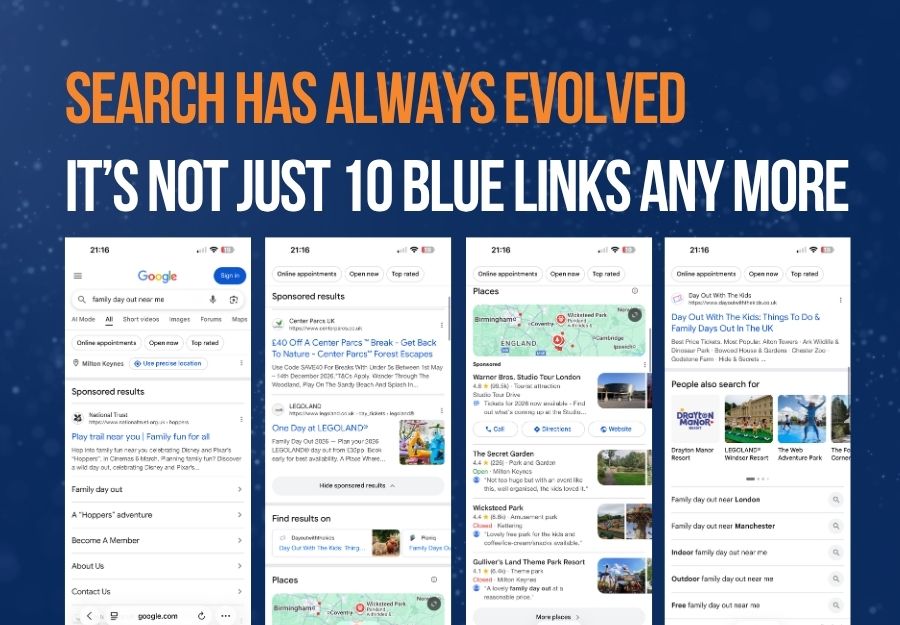
Yes and no. Search has always evolved, and AI Search (AEO / GEO) is just another step... although this time it's happening faster than anyone predicted.
The traffic picture is changing
Fewer people are going to land on your website after a Google search. AI assistants are absorbing the information job - opening times, what's included, how to get there, what other visitors thought.
A family planning a day out can get a pretty complete picture of your attraction without ever clicking through to you.
That sounds alarming. But here's the flip side: the people who do click through are further down the decision-making journey. They're not browsing, they're more qualified guests and they're more likely to buy. Fewer visits, higher intent. Your website's job shifts from attracting attention to closing the deal.

Your website shapes what AI says about you
This is the bit that doesn't get talked about enough - your website can (and should) be the number one best place for guests (and AI bots) to get answers about your attraction.
AI doesn't invent information about your attraction. It absorbs and interprets what already exists - your website, your reviews, what other sites say about you. Which means if your content is thin, AI gives thin answers. If a competitor has richer, more structured, more authoritative content, AI makes them sound better than you. If content is outdated, wrong or inconsistent, the AI tools are more likely to present inaccurate information or use less reliable sources.
Keeping on top of your content and reviews online now is absolutely key to your attractions' success.
The attractions that invest in genuinely good digital content that's accurate, presented well and showcases the attraction well are the ones that will start to perform better in AI. The ones that don't are liable to get whatever the internet has cobbled together about them.
That's a shift in what "good content" means. It's not just for humans anymore.
The fundamentals haven't changed - but the stakes have increased
Google published its official AI search optimisation guide in May 2026. And reassuringly, the message is straightforward: the things that made your website perform well in traditional search are the same things that make it perform well in AI search.
- Logical structure and clean technical foundations
- Strong SEO as the base layer
- Content that's helpful, specific, and people-first
- A fast, accessible, mobile-ready experience
No magic tricks. No separate AI strategy to bolt on. Just solid foundations, done properly.
What's changed is the consequence of not doing those things. When traffic volumes were higher, a mediocre website still converted enough visitors to feel acceptable. As volumes reduce and intent increases, a poor website has a bigger impact. Every visit counts more.
What to do right now
Here are 5 practical steps that tie directly into Google's own guidance:
- Audit your structure. Can AI agents,. and real visitors, navigate your site logically? Clear page hierarchy, sensible URLs, no buried information.
- Check your technical health. Speed, mobile experience, no duplicate / inconsistent or outdated content.
- Invest in content that only you can write. Your story, your team's expertise, what genuinely makes your attraction different and showcases value.
- Test yourself in AI. Ask ChatGPT or Google's AI Mode about your attraction. Is the information accurate? Is your offering described well? If not, that's a content gap to close.
- Make the booking moment count. AI might do the research. The handoff to purchase still happens on your site. That experience has to be fast, clear, and simple for your guests.
The bottom line
AI hasn't killed the need for a great website but it is changing what a great website needs to do, as well as raising the cost of having a poor one.
Fewer visitors. Higher intent. No room for a website that doesn't do its job.
The attractions that get this early will hold their ground. The ones that don't won't get replaced by AI - they'll just become invisible, because they never gave AI what it needed to showcase their brand.
So here's a quick check to do this week with your team:
- Open ChatGPT or Gemini
- Search for your attraction.
- Is what comes back accurate? Is it compelling? Does it reflect what makes you worth visiting?
- If the answer is "not really" - that's your starting point. Fix the content. Fix the structure. Give AI something to work with.
Stuck... ask the AI! Or drop us a line and we'll be happy to help audit your site and give you pointers in an increasing AI-first world.
Because right now, while most attractions are still ignoring this, the gap between the ones who act and the ones who don't is widening fast.